The Anchorage Tech-Stop Comeback: Which Aircraft Need ANC to Go Around Russia
From the mid-1960s through 1991, Anchorage was a scheduled tech-stop (short for technical stop: a landing made purely to take on fuel, with the passengers usually staying aboard) on Pan Am, JAL, KLM, Lufthansa, and British Airways flights between Europe and East Asia. Soviet airspace was closed, the early widebodies could not cover the polar arc nonstop, and ANC sat directly under the route. When Soviet airspace opened, the stop disappeared from the timetables within a decade. The 2022 Russian closure brought back the same geographic constraint. The modern long-range fleet absorbs most of the extra arc, but a meaningful slice of today's narrowbody and older widebody operations is squarely back in 1985 conditions.
The Detour Math
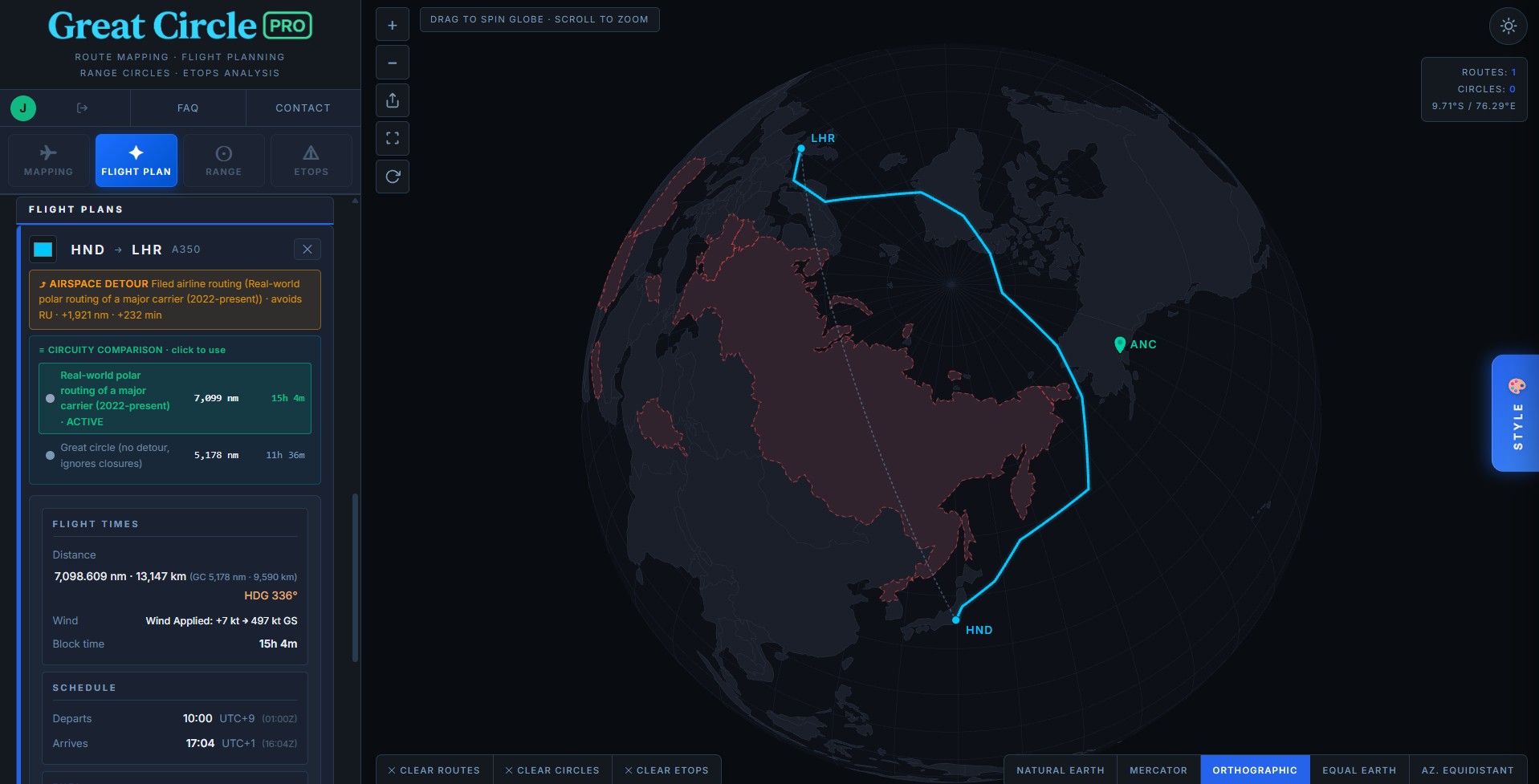
Start with the geometry. The London to Tokyo great circle, the genuinely shortest path over the curved surface of the earth, is 5,178 nautical miles. On a globe that line arcs up toward the pole; on a flat map it looks bent, but it really is the shortest distance, and before 2022 it was very close to what airlines flew. The route they fly today is 6,800 to 7,100 nautical miles, depending on whether the day's flight plan takes the polar variant up over Alaska or the southern variant down through the Caspian and Central Asia. The figure below captures the polar version: that 5,178 nm great circle stretched to 7,099 nm of real track, a penalty of 1,921 nautical miles and 232 extra minutes. That is nearly four additional hours in the air, on every single flight, and it is the largest persistent detour in commercial aviation right now.
The same kind of penalty can hit Frankfurt to Tokyo (about 1,400 nm extra), Paris to Tokyo (about 1,500 nm extra), and Helsinki to Tokyo (among the hardest-hit European pairs, almost 2,000 nm because Finnair's pre-2022 routing crossed Russia for much of the flight). It can also hit Delhi to New York (about 1,500 nm extra). It does not affect transatlantic flights, North America to Europe flights, or routes that never need a Eurasian overflight.
The Range Threshold
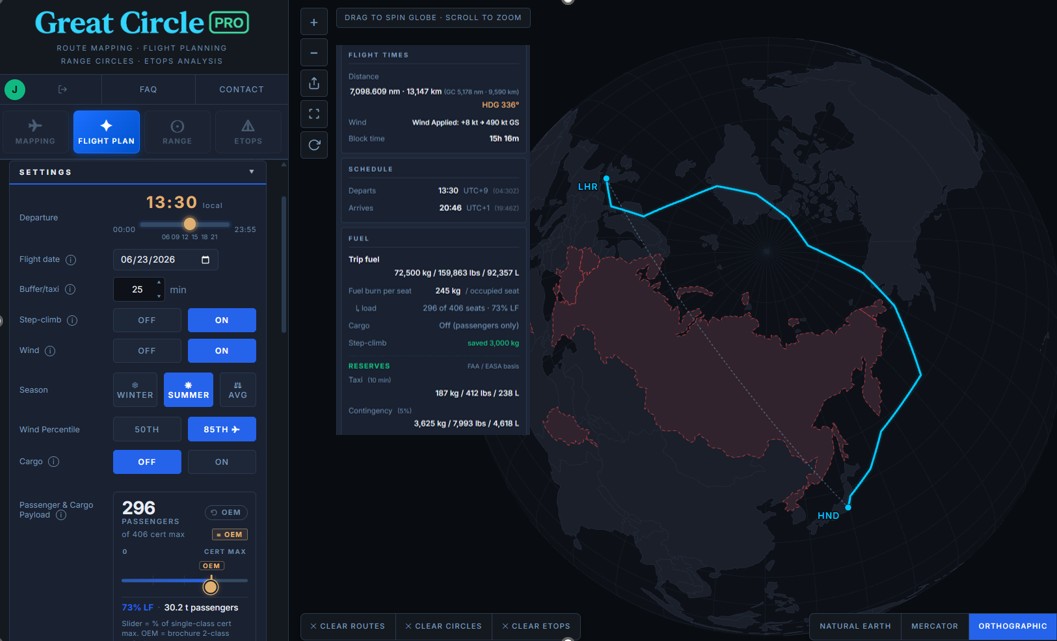
The flyable LHR-to-Tokyo arc is around 7,000 nm. Add the usual reserves (taxi, contingency, alternate, final reserve fuel, and a headwind margin for the directional case) and the airframe needs roughly 7,300 nm of usable range to do the trip comfortably in winter when the route is fighting a jet stream on the westbound leg. Aircraft sitting near or below that threshold cannot dispatch nonstop without either restricting payload or accepting tighter reserve margins than dispatch wants to sign off on.
That single number, about 7,300 nm, is what sorts the modern fleet into three categories.
Category A: Nonstop with Margin
These airframes absorb the detour with comfortable reserves and full passenger / cargo load. They do not need a tech-stop and do not run payload restrictions for the Russia avoidance pattern.
| Aircraft | Range (nm) | Margin vs detour | Status |
|---|---|---|---|
| A350-900 ULR | 9,700 | +2,400 nm | Nonstop, comfortable |
| A350-1000 | 8,400 | +1,100 nm | Nonstop, comfortable |
| A350-900 | 8,100 | +800 nm | Nonstop, comfortable |
| Boeing 777-300ER | 7,370 | +70 nm | Nonstop, tight in winter |
| Boeing 787-9 | 7,565 | +265 nm | Nonstop, workable |
| Boeing 777-8 (777X) | 7,285 | -15 nm | Borderline by design |
| Gulfstream G650 / G650ER | 7,500 | +200 nm | Nonstop, workable |
| Bombardier Global 7500 | 7,700 | +400 nm | Nonstop, comfortable |
The 777-300ER's listed 7,370 nm and the 787-9's 7,565 nm are both close to the threshold, and in real winter operations both occasionally see payload restrictions on the westbound LHR-HND leg, when 250-knot jet-stream headwinds combine with full fuel and full passengers to push the airframe over its MTOW (maximum takeoff weight, the heaviest the airplane is certified to leave the ground at) for the conditions of the day. The 787-9 is the workhorse for most carriers on this routing because of its fuel economy, but it lives near the edge in January and February.
Category B: Nonstop but Restricted
These airframes can technically make the trip but only by giving something up. The trade is usually some combination of reduced payload, reduced cargo, increased headwind season tech-stops, or accepting reserve fuel at the regulatory minimum rather than the operator's preferred margin.
| Aircraft | Range (nm) | Margin vs detour | Status |
|---|---|---|---|
| Boeing 787-8 | 7,355 | +55 nm | Restricted payload westbound |
| A330-900neo | 7,350 | +50 nm | Restricted payload westbound |
The 787-8 is the more interesting case here. Its published range of 7,355 nm puts it within sight of the detour distance, but the airframe was sized for a different operational reality: the 6,800 nm transpacific market with a useful payload. The 2022 closure essentially turned the 787-8 from a comfortable LHR-NRT airplane into a marginal one. Several operators have shifted those flights to the 787-9 specifically for this reason.
Category C: Tech-Stop Required
These airframes cannot make the Europe-to-East-Asia detoured arc at all. For any operator using them on this routing, the tech-stop is not optional. ANC is the natural choice for the polar variant; Reykjavik (KEF), Dublin (EIDW), or Helsinki (EFHK) work for the southern variant.
| Aircraft | Range (nm) | LHR-ANC fit | ANC-HND fit |
|---|---|---|---|
| Airbus A321XLR | 4,700 | 3,900 nm: comfortable | 3,000 nm: comfortable |
| Airbus A321LR | 4,000 | 3,900 nm: very tight | 3,000 nm: workable |
| Boeing 757-200ER (historical) | 3,900 | 3,900 nm: zero margin | 3,000 nm: workable |
| A320neo | 3,500 | 3,900 nm: out of range | 3,000 nm: workable |
| Boeing 737 MAX 8 | 3,500 | 3,900 nm: out of range | 3,000 nm: workable |
| A220-300 | 3,450 | 3,900 nm: out of range | 3,000 nm: workable |
| Boeing 747-8F / 777F (max-cargo dispatch) | 4,390-4,910 | 3,900 nm: workable | 3,000 nm: comfortable |
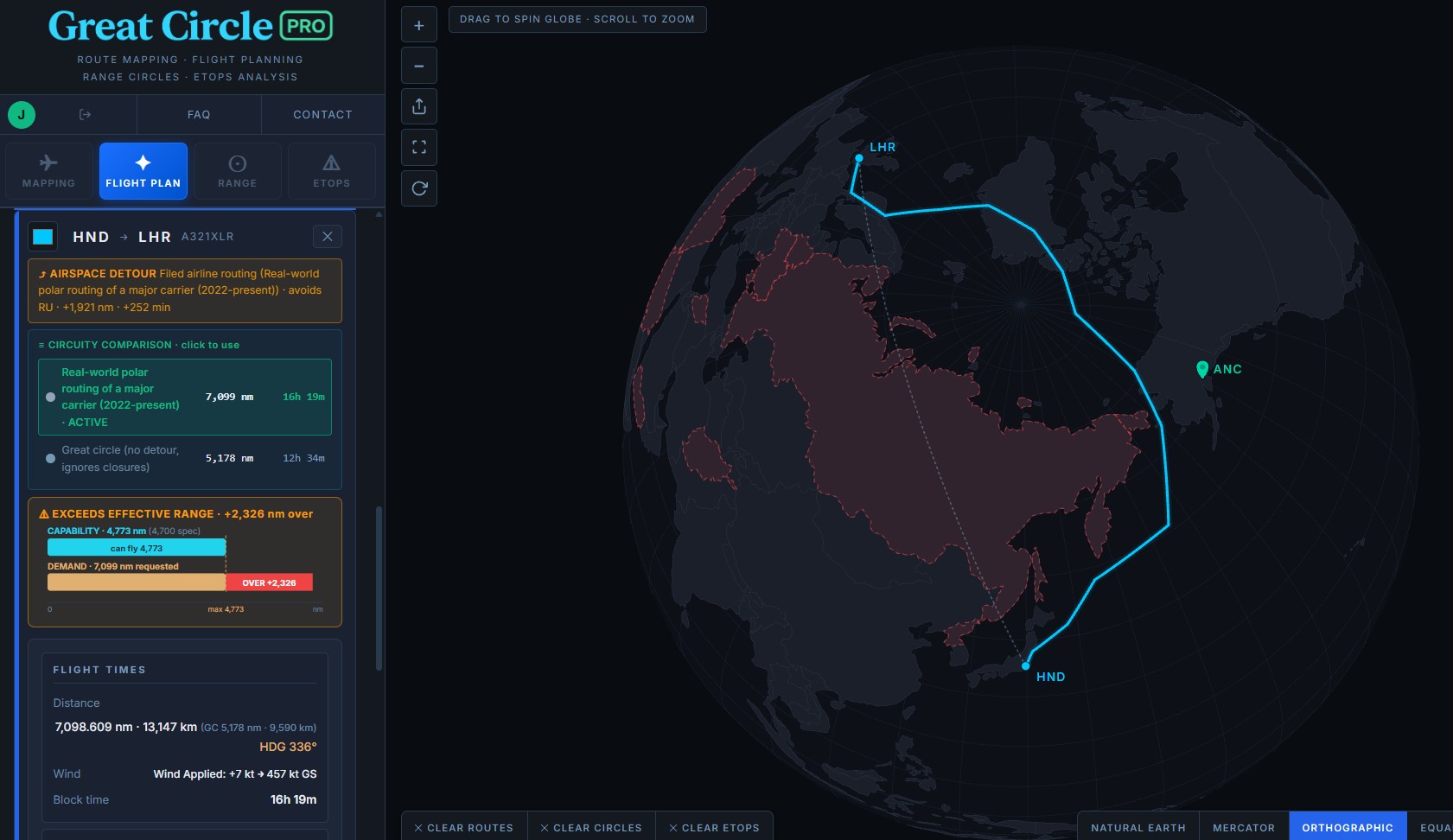
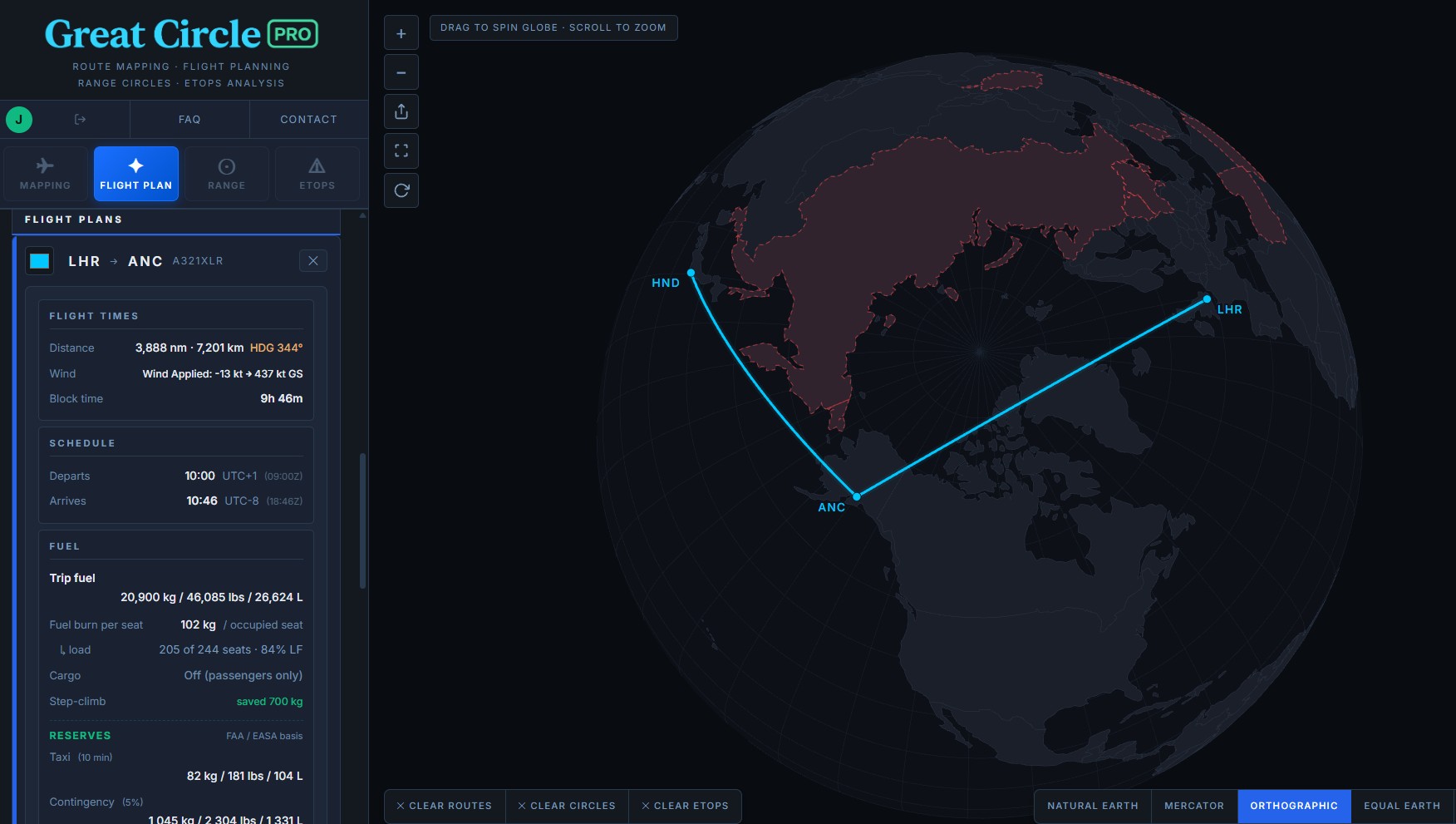
The A321XLR is the obvious case. It is the only single-aisle airliner currently in production with the legs to make any meaningful nonstop transatlantic or transpolar service, and even it tops out at 4,700 nm. From London, it cannot reach Tokyo or Seoul under any routing pattern, with or without the Russian detour. But LHR to Anchorage is 3,900 nm direct over the pole, and ANC to Tokyo Haneda is 3,000 nm. Both legs sit comfortably inside the airframe.
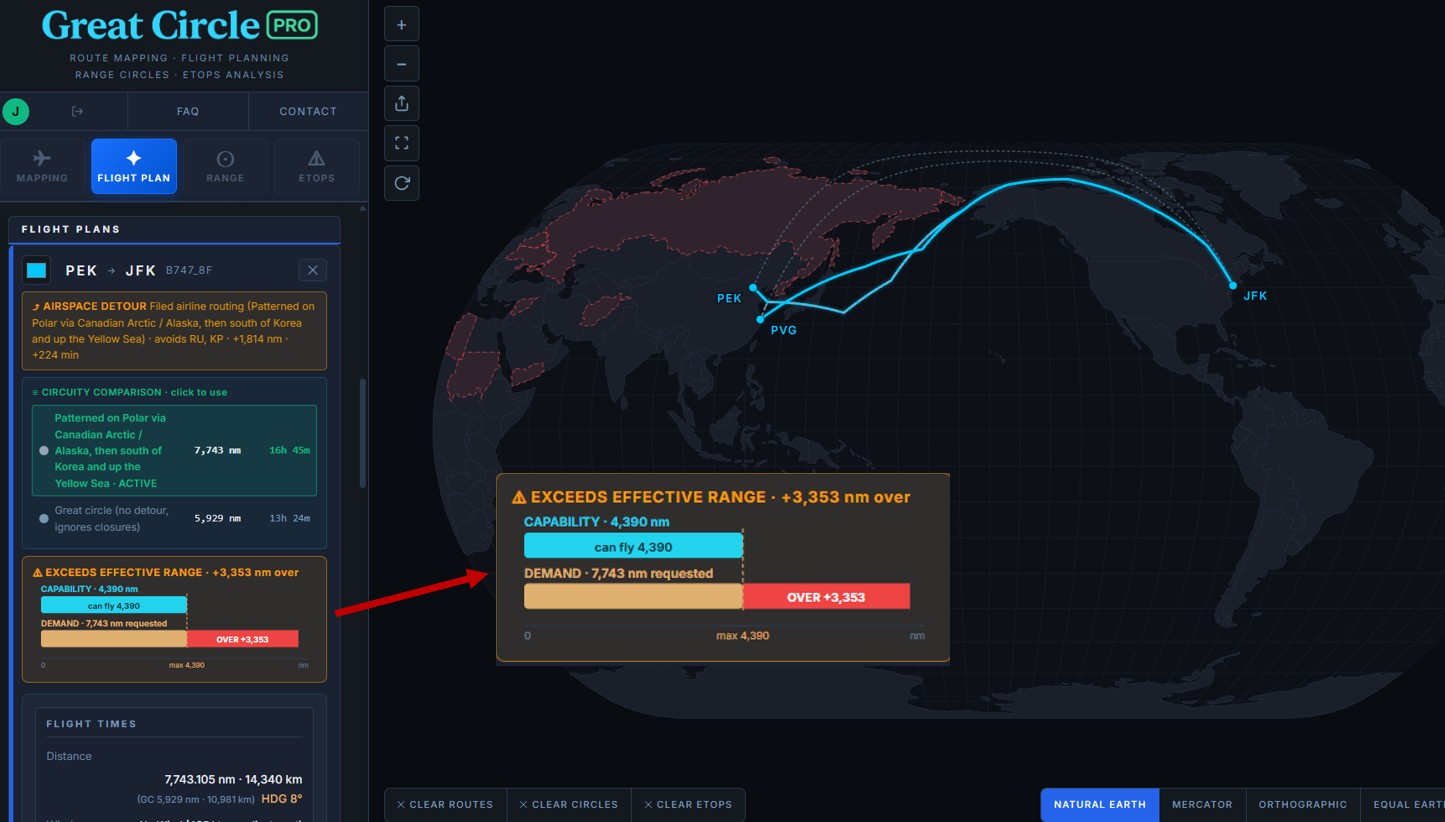
The cargo case is even more acute. The Boeing 747-8F and 777F at maximum structural payload give up hundreds of nautical miles below their nominal published range. For a max-payload flight over the pole, the polar arc plus a quick ANC fuel stop opens up payload combinations that would not otherwise close nonstop. The stop buys payload, not just range. That single fact is the reason Anchorage is what it is today, which is worth its own section.
The Geographic Logic of Anchorage
Anchorage is at 61 degrees north and 150 degrees west. The great-circle arc from London to Tokyo passes within a few hundred nautical miles of it. The great-circle arc from Frankfurt to Seoul passes nearer still. The great-circle arc from Chicago to Hong Kong passes almost over PANC. There is no other commercial airport in the right place: the next-nearest reasonable candidates are Reykjavik to the east (good for the European leg of the polar arc but not for the Asia leg) and Petropavlovsk-Kamchatsky to the west (in Russian airspace, which is the entire reason the detour exists in the first place).
The infrastructure side has not eroded much in the 30 years since the polar tech-stops disappeared from passenger timetables. PANC runs multiple 10,000-ft-plus runways, including a 12,400-ft runway, has US Customs and Border Protection on-site for international cargo processing, sells JET A in the volumes required for widebody and large-narrowbody refueling, and has the gate / parking footprint for sustained transit traffic. The cargo carriers kept the lights on through the lean years; the passenger side now has the option of joining them.
The remaining question for passenger operations is not technical. It is commercial. A 90-minute tech-stop on a 14-hour itinerary adds friction the modern long-haul passenger has been trained to dislike. Premium-cabin passengers in particular pay for nonstop. The carriers that historically used ANC dropped the stop the instant Soviet airspace opened, and the muscle memory of "premium product equals nonstop" runs deep. The most likely candidates for a revived passenger tech-stop are the narrowbody startups (think TAP Air Portugal or JetBlue style transatlantic experiments extended to Asia) and the low-cost long-haul carriers, where customers have already been sorted into the "would accept a stop for a lower fare" bucket.
Anchorage Today Is Already the Tech-Stop Capital
The passenger tech-stop is a "maybe it comes back" story. The cargo tech-stop never went away, and today it is bigger than ever. Ted Stevens Anchorage International is consistently among the top three cargo airports on Earth by tonnage, behind only Hong Kong and Shanghai Pudong in the 2025 ACI ranking, and it is the largest cargo airport in North America. Almost none of that freight starts or ends in Alaska. It is transit: widebody freighters stopping to refuel on the great-circle arc between Asia and the rest of the world.
The driver is the same geometry as the passenger case, applied to airplanes that are far more range-sensitive. A 747-8F or 777F dispatched at maximum structural payload gives up a large slice of its nominal range; a freighter rated near 4,800 nm empty might only make 3,500 nm with the floor full. The arc from a Chinese, Korean, or Japanese manufacturing hub to a European or US distribution center is 4,500 to 5,500 nm, and it runs almost directly over Anchorage. Rather than leave revenue cargo on the ramp to make the distance, the carrier loads to the limit, flies the leg that fits, refuels at ANC in well under two hours, and continues. The stop converts range margin into payload, and on a freighter payload is the entire business.
FedEx Express and UPS Airlines both run major transit operations at the field. Atlas Air, Kalitta Air, ATSG, Cathay Cargo, Korean Air Cargo, China Airlines Cargo, and Nippon Cargo Airlines move hundreds of weekly widebody freighter movements through PANC, the overwhelming majority of them fuel stops on Asia-to-North-America and Asia-to-Europe lanes. When the trade press says the majority of air freight between Asia and the West touches Anchorage, that is not a slogan. It is the tonnage arithmetic of range-limited freighters flying a polar arc that happens to cross one exceptionally well-equipped airport.
The 2022 Russian closure sharpened the Asia-to-Europe half of this picture specifically. Those freighter lanes used to cross Siberia; now they arc north over Alaska like the passenger routes, which pulls even more freighter traffic into the Anchorage catchment. The cargo carriers kept the lights on at PANC through the thin passenger years. They are now busier than ever, and the geometry says they will stay that way as long as the airspace stays closed.
What This Looks Like in Great Circle Pro
The Flight Plan tool makes the categorization above directly testable. Plot a route between London and an Asian destination, choose the aircraft, and turn the Airspace toggle on. The tool routes the leg around the closed Russian airspace, reports the routed distance against the great-circle figure, and flags the moment that routed distance runs past the airframe's effective range. A Category A aircraft like the 787-9 returns a workable block time; an A321XLR returns the exceeds-range warning, which is the visual version of "this one needs a stop."
To model the Anchorage tech-stop itself, plot the two legs and check each one. The Flight Plan tool treats every leg independently, so you can confirm that both the transpolar LHR-ANC leg and the onward ANC-Asia leg sit inside the airframe even when the single nonstop does not. For the A321XLR, those two legs reach most of the Northeast Asian coastline.
A Forty-Year Loop
The interesting thing about the modern Anchorage case is not that it is novel. It is that it is repeated. The 1960s and 70s tech-stop pattern was driven by the combination of closed Soviet airspace and the limited range of the 707 and early 747 variants. When the 747-400 and the 777-200ER arrived in the 1990s with nonstop capability, the stop disappeared from the timetables for exactly the airframes that could now skip it. The mid-2020s case is the same closed airspace with a different fleet split: the wide-body long-range types skip the stop, the narrowbody and freighter types need it. The geographic logic does not change.
The lesson for network planners is straightforward: when a planning constraint is geographic, the routing that solves it tends to look the same across generations. Anchorage was the answer in 1965, in 1985, and again in 2026. The only thing that varies is which airframes are sitting on the right side of the range threshold to skip it.
A footnote on Reykjavik and Helsinki. For European narrowbody operations going to South Asia or Middle East destinations, the southern detour variant uses KEF (Reykjavik) or EFHK (Helsinki) as the natural tech-stop. Icelandair built its entire transatlantic business around the KEF stopover, and the same idea extends naturally to Asia routings on the A321XLR. Finnair's pre-2022 Asian network was built on the geographic advantage of HEL sitting near the western edge of the Russian closure. Both airports remain credible candidates for narrowbody Asia routings on the southern variant; PANC is the polar variant. Chain a route through any of them in the Flight Plan tool to see the per-leg reach for whichever variant you want to model.