How Far Can a Private Jet Fly Nonstop?
Somewhere between 1,200 and 7,700 nautical miles, which is a polite way of saying the question has no single answer. A Vision Jet and a Global 7500 are both "private jets" the way a rowboat and a container ship are both boats. So instead of one number, here is the honest version: every class of business jet, its real reach drawn as range rings on an actual map, the city pairs each ring opens, and the quiet derates that separate the brochure from the airplane you board.
The Short Answer, by Class
Published maximum ranges, with a mission that shows what the number actually buys. Every distance is a true great circle computed from airport coordinates.
| Class | Example | Published range | What that buys |
|---|---|---|---|
| Personal jet | Cirrus SF50 Vision Jet | 1,200 nm | Teterboro to Miami (956 nm) with margin |
| Very light jet | HondaJet Elite II | 1,437 nm | Teterboro to Aspen (1,502 nm) on a favorable day |
| Turboprop | King Air B200 | about 1,500 nm | The workhorse: two hops cross the country |
| Light jet | Citation CJ3 | 2,040 nm | Coast to coast (2,130 nm) is right at the edge |
| Super midsize | Citation X | 3,460 nm | New York to London (2,994 nm) opens up |
| Large cabin | G-IV / G500 | 4,220 / 5,300 nm | Teterboro to São Paulo (4,155) or Honolulu (4,308) |
| Ultra long range | G550 / G600 / Global 6500 | 6,600 to 6,750 nm | Almost anywhere with one crew rest |
| The top of the class | G650ER / Global 7500 | 7,500 / 7,700 nm | New York to Tokyo or Dubai, nonstop |
Now look at what those numbers mean on a map. Below are three of those airplanes drawn from the same ramp at Teterboro, the busiest business jet airport in America, with the winter wind model switched on. The projection is azimuthal equidistant, the one built for range work, so distance from the center is true in every direction. Notice the rings are not perfect circles. They are not supposed to be.
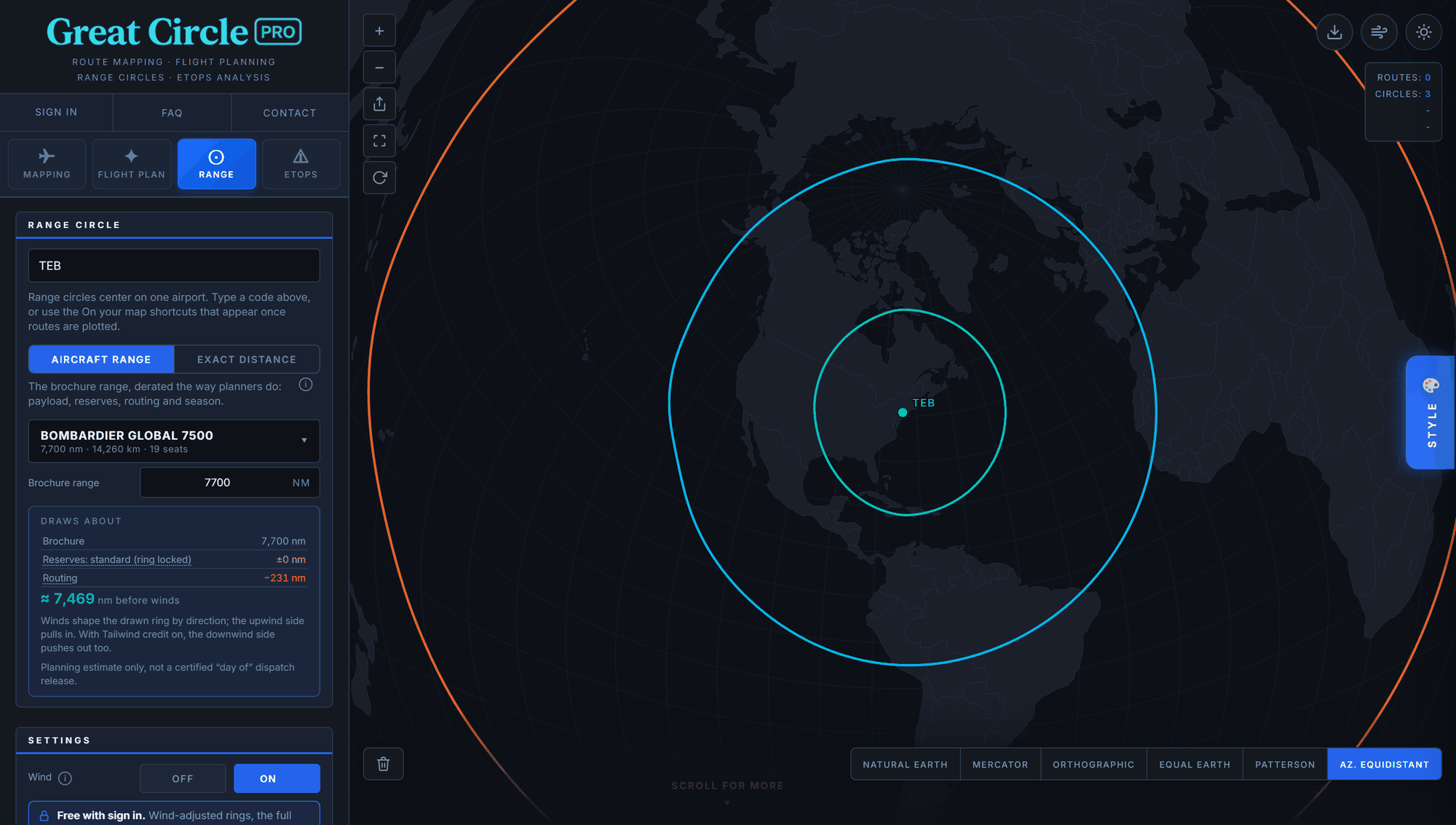
Same ramp, three different worlds: HondaJet (green), Citation X (blue), Global 7500 (orange), winter wind-adjusted rings from Teterboro. Each ring pulls in on its western side. That dent is the jet stream.
The green ring is a HondaJet: the eastern half of the country. The blue ring is a Citation X: the whole hemisphere from Alaska to the Amazon, and London at a stretch. The orange ring is a Global 7500, and it is barely on the map. That is the entire private jet market in one picture. You are not buying speed, which is nearly identical across these jets. You are buying circle.
The Brochure Number vs the Airplane You Board
Look closely at the sidebar in that screenshot and you will see the tool being honest. The Global 7500's brochure says 7,700 nautical miles. The drawn ring is about 7,469. Where did 231 miles go? Routing. Filed IFR routes run a few percent longer than the perfect great circle, so the reachable radius shrinks before wind or weather say a word. And that is the friendliest of the derates:
- Payload. The published range assumes a light cabin, typically four to eight passengers. Fill every seat and berth for a long trip and the fuel budget gives first. The trade lives on the payload range curve, the machinery behind every range circle.
- Reserves. No one plans to land dry. A typical business jet release carries NBAA style IFR reserves: fuel to the destination, then to an alternate, then 45 minutes of holding. That fuel rides the whole way and never gets burned on purpose.
- Winds. Westbound against a winter jet stream, block time stretches and effective reach shrinks. Scroll back to the rings above and look at their western edges pulling in: that is the jet stream, already drawn. It is why marginal trips work eastbound and become fuel stops westbound.
- Hot and high airports. Aspen in July takes off with less than Aspen in January. Elevation and temperature cut takeoff weight, which cuts fuel, which cuts range. The mechanics are in our hot and high explainer.
The transcon test. A light jet's brochure says 2,040 nm. Teterboro to Van Nuys is 2,130 nm by geometry, and the filed route is longer still. Eastbound with a tailwind the trip usually closes. Westbound in winter it usually does not, which is why the classic light jet transcon includes twenty minutes in Wichita. One number, two different airplanes depending on the direction of the wind.
What the Top of the Class Really Does
Here is the Global 7500's ring again, winter winds still on, with four real missions drawn from Teterboro: London (2,994 nm), São Paulo (4,155 nm), Tokyo (5,855 nm), and Dubai (5,941 nm). On this projection, every great circle through the center is a straight line, so the routes radiate like spokes. Watch the ring's shape as it passes Tokyo's side of the map: that is the direction the winter headwinds punish, and the ring pulls in exactly there. All four missions still end inside it.
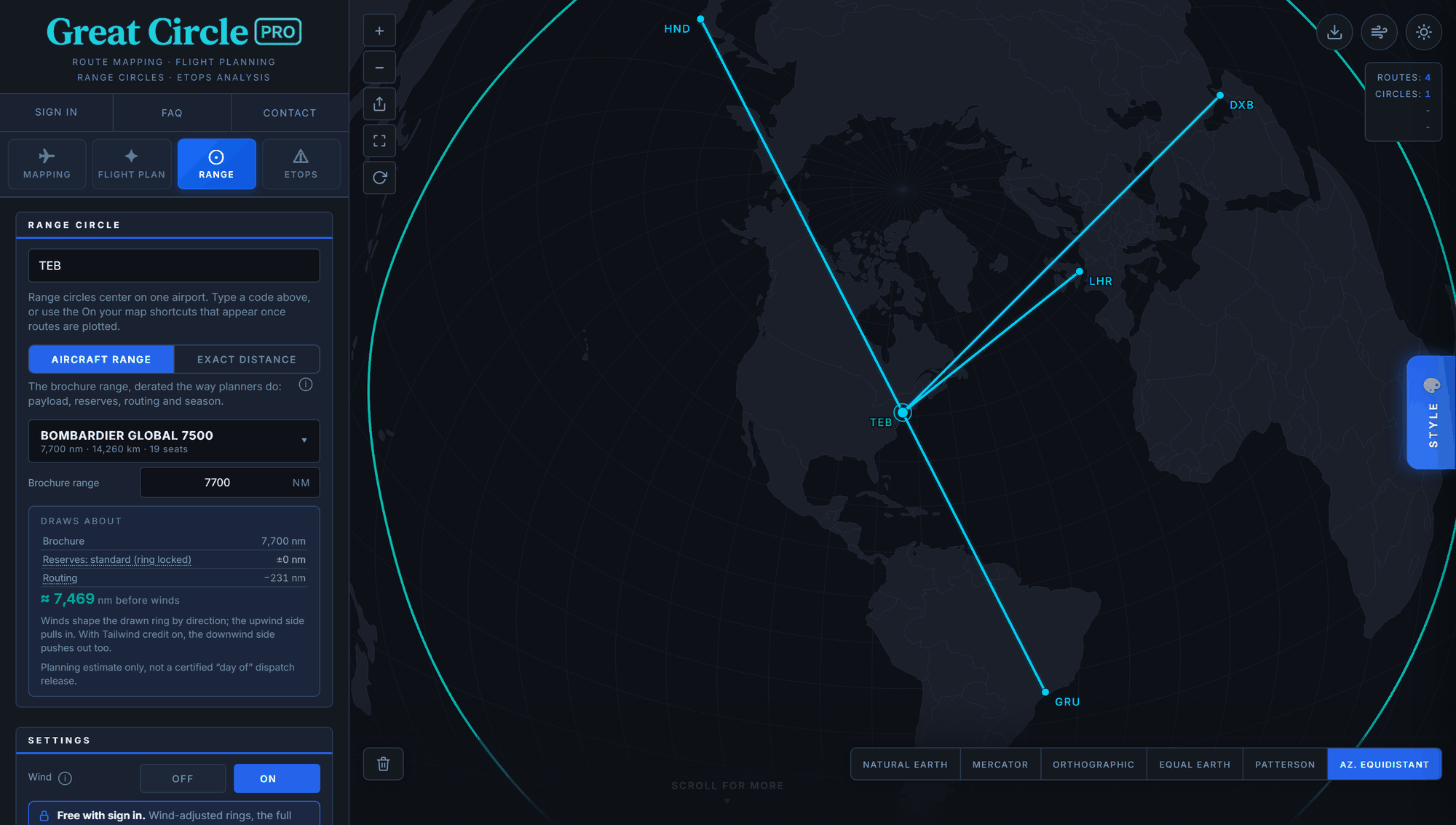
One airplane, one ramp, winter winds on: London, São Paulo, Tokyo and Dubai all land inside the Global 7500's ring, with the ring leaning away from the headwind side.
That is what 7,700 nautical miles means in practice: from the New York area, essentially every business capital on the planet is one takeoff away. The airplanes that fly these missions cruise 14 to 17 hours, which is why they carry beds, showers on some, and two full crews. The newest generation, led by Gulfstream's and Bombardier's latest flagships, pushes the headline toward 8,000 nautical miles, chasing the last few city pairs that still require a stop, like New York to Singapore against the winter wind.
Where the Small Jets Stop
None of this makes the little jets lesser airplanes. It makes them different tools. A Vision Jet owner flying Teterboro to Miami does the trip in one hop with margin, at a fraction of the operating cost. A CJ3 covers ninety percent of American business flying without ever needing the second hop. The mistake is not buying a small ring. The mistake is buying a ring without looking at a map of your actual missions first, because the difference between 2,040 and 2,130 nautical miles is the difference between nonstop and not.
Draw your own mission map in ten seconds. Open gcpromap.com with the winter wind-adjusted Global 7500 ring pre-drawn from Teterboro, or start from scratch: open the map tool, go to the Range tab, type your home airport, and pick an aircraft. The ledger under the range box shows exactly what the brochure number becomes after payload, reserves and routing, before you ever draw. Flip the season and watch the upwind side of the ring move. Then add your real destinations on the Mapping tab and see which ones fall inside.
Frequently Asked Questions
How far can a private jet fly without refueling?
Personal jets about 1,200 nautical miles, light jets about 2,000, super midsize about 3,500, large cabin 4,000 to 5,500, and the ultra long range flagships 7,500 to 7,700. The spread is wider than most people expect: the biggest ring is six times the smallest.
Can a private jet cross the Atlantic nonstop?
From the super midsize class up, yes. New York to London is about 3,000 nautical miles, inside a Citation X class ring in still air and easy for anything larger. Light jets do it with a fuel stop, classically Gander and Shannon. Westbound winter headwinds are what break marginal trips.
What private jet has the longest range?
In wide service today, the Global 7500 at about 7,700 nautical miles, with the G650ER at 7,500 close behind. The newest flagships push toward 8,000, aiming at the last unserved nonstops.
Why is real range less than the brochure?
The brochure assumes a light load, still air and standard reserves. Real trips carry full cabins, NBAA style IFR reserves, routing that runs longer than the great circle, and seasonal winds. Plan on the derated ring, not the headline.
A note on the numbers. Published ranges are the manufacturers' standardized figures at typical loading, and the rings shown are winter wind-adjusted planning estimates, built from a pre-wind basis after payload, reserve and routing adjustments, not certified performance data. Real dispatch depends on the day's weather, weight, runway and route. The distances between airports are pure geometry and do not change.